On January 3, 2026, a U.S.-led military operation successfully captured Venezuelan President Nicolás Maduro and his wife, Cilia Flores, during a large-scale strike on Caracas and other targets. President Donald Trump announced the operation, which removed the couple from the country to face U.S. charges, including narco-terrorism.
While the intervention has drawn international criticism and raised concerns over potential instability, it also presents significant potential positives for Venezuela and the broader region. Central among these is the opportunity to revive the nation’s oil industry, long crippled by structural challenges that rendered much of its vast reserves unprofitable despite holding the world’s largest proven oil reserves.
My own early thinking is Venezuela’s gave him up and it was more of a palace coup than an intervention, but time will tell.
Venezuela’s oil sector has been paradoxically unprofitable for years…
… despite reserves exceeding 300 billion barrels—primarily extra-heavy crude from the Orinoco Belt with API gravity typically 8–10°. This crude is highly viscous (often >1,000–10,000 centipoise), rich in asphaltenes, sulfur (4–6 wt%), and metals like vanadium and nickel, requiring specialized processing. To flow through pipelines, it must be diluted with lighter hydrocarbons (naphtha or condensate), consuming 20–30% of volume as diluent.
Export often involves blending into Merey-16 grade, but true profitability demands upgrading via delayed coking or hydrocracking to produce synthetic crude (20–30° API). Upgraders in the Jose Industrial Complex have been offline or under-maintained since 2019–2021 due to lack of investment, forcing sales of raw heavy crude at steep discounts ($10–30/barrel below benchmarks like Brent).
Compounding these technical hurdles were operational inefficiencies under prior management.
PDVSA suffered from chronic underinvestment, decaying infrastructure, and shortages of diluent, power, and spare parts. Production plummeted from over 3 million barrels per day (bpd) in the early 2000s to around 900,000–1.1 million bpd in late 2025, far below capacity. Corruption diverted billions—estimates range from $11 billion (2004–2014) to hundreds of billions overall—while skilled workers fled, eroding expertise. Sanctions restricted access to capital, technology, and markets, forcing discounted sales via shadow fleets.
And for all the bitching about the US wanting the oil, China lost 40-60 billion on their investments there.
Maduro’s removal opens pathways to address these root causes.
Sanctions relief could attract major investors like Chevron and ExxonMobil, already familiar with Orinoco operations. President Trump has emphasized U.S. involvement in revitalizing production, potentially ramping output rapidly through joint ventures. Restoring upgraders and importing diluent freely would enable higher-value exports, improving netbacks and profitability. Market reforms could prioritize efficiency over patronage, reducing waste and corruption. Increased production—analysts project 2 million bpd within 1–2 years under favorable conditions—would generate jobs, stabilize prices, and alleviate shortages in food, medicine, and services.
Humanitarian conditions stand to benefit indirectly from this revival.
Oil revenues, historically 90–95% of exports, could fund imports and infrastructure repairs, easing malnutrition and healthcare deficits affecting millions. Right now, Venezuela is losing money on every barrel they sell. The reason they operate at a loss is it’s their only way of getting foreign currency and even then, it’s probably Yuan.
Regionally, higher Venezuelan output promises greater stability.
For Colombia, hosting nearly three million Venezuelan migrants, economic recovery could encourage voluntary returns, reducing strains on services and borders. Enhanced cooperation might also improve joint efforts to combat cross-border crime, including drug networks active in shared regions, bolstering security and economic recovery for Colombia. Guyana gains from de-escalated tensions over the Essequibo region, allowing uninterrupted development of its offshore discoveries without prior threats.
Another significant positive lies in the potential resurgence of Venezuela’s tourism industry.
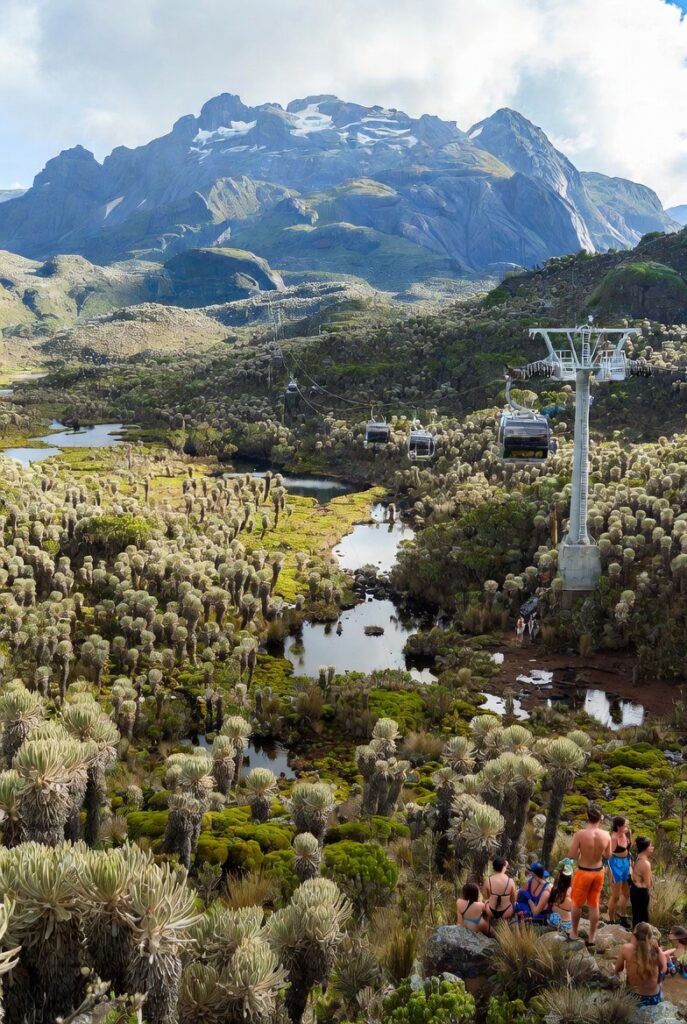
It has been long suppressed by instability, poor infrastructure, and safety concerns. The country boasts extraordinary natural attractions, including Angel Falls—the world’s tallest uninterrupted waterfall at 979 meters in Canaima National Park, a UNESCO World Heritage Site featuring dramatic tepuis (tabletop mountains), savannas, and lagoons.
Pristine Caribbean destinations like the Los Roques Archipelago offer turquoise waters, coral reefs, and white-sand beaches ideal for diving and snorkeling, while Margarita Island provides vibrant beaches, duty-free shopping, and cultural sites. The Andean region in Mérida features high peaks, cable cars, and páramo landscapes, complemented by coastal parks like Morrocoy and Mochima with mangroves and cays.
Prior challenges—hyperinflation, crime, flight restrictions, and power outages—devastated tourism, dropping revenues from over $1 billion in 2008 to fractions thereof. With renewed stability and investment from oil revival, infrastructure improvements (airports, roads, hotels) could follow, alongside better security and marketing. This diversification beyond oil would create jobs in hospitality, guiding, and transport, attracting eco-tourists, adventure seekers, and beachgoers. Combined with oil-funded development, tourism could become a sustainable revenue stream, drawing international visitors eager to explore one of South America’s most biodiverse and visually stunning nations.
Overall, this shift offers a turning point.
Transforming unprofitable reserves into a sustainable engine of growth. Families separated by emigration may reunite, and communities could rebuild amid renewed prosperity.
While transitional risks persist, the potential—economic revival through profitable oil exploitation, humanitarian relief, regional peace, and tourism growth—provides strong grounds for optimism. Venezuela has a chance to harness its resources effectively and thrive.
I realize that dreamers think democracy is a utopia.
But you can’t run a democracy if the leaders are thugs, and the government is layered with systemic corruption. All of Venezuela’s problems are self-imposed. Tin pot dictators proliferate all over south and central America. Colombia was stabilized and made prosperous by a huge contribution during the Bush years. It’s in the process of backsliding into shit hole status under the FARC leader Petro.
My hope if that the US gets out of the middle east and Europe and concentrates on its own hemisphere. I’m in the minority but I’ve lived in these areas. They are truly worth redeeming.