The shift in oil prices from 1982 to 2026 caused a radical change in home affordability as interest rates fell, the cost of driving fell and the US had a massive buildout of “far suburbs.” That system seems to be reversing itself.
The structure of U.S. housing demand is closely tied to energy costs, especially the price of oil, because the American suburban model depends on inexpensive commuting and dispersed infrastructure. For decades, cheap fuel and expanding highways made it possible for households to live farther from job centers while maintaining access to urban employment.
- Higher commuting costs shift demand inward
When oil prices rise, gasoline becomes more expensive, increasing the cost of daily commuting. As a result, households reassess location decisions and tend to favor homes closer to jobs or transit. Research shows that higher fuel costs reduce demand for housing in areas with longer commutes and shift demand toward closer-in locations. - Outer suburban growth slows over time
Higher gasoline prices do not usually cause a sudden drop in prices in outer suburbs, but they do reduce construction and future development in those areas. Developers respond by building less in long-distance locations, leading to a gradual slowdown in suburban expansion. - Demand tilts toward density and connectivity
As transportation costs rise, households increasingly trade larger homes for better access. This means more demand for housing near employment centers, transit corridors, and walkable neighborhoods, where ongoing commuting expenses are lower. - Relative pricing shifts emerge across locations
Homes farther from city centers tend to become less attractive relative to those closer in. Even if absolute prices don’t drop immediately, the growth rate of distant suburban home values weakens compared to more central, accessible locations. - Car-dependent living becomes structurally more expensive
Suburban homes bundle multiple ongoing costs: fuel, time spent commuting, and reliance on vehicles. As oil prices rise, this lifestyle becomes more expensive overall, reducing its relative affordability compared to urban living. - Infrastructure inefficiencies amplify the effect
Suburban sprawl requires more roads, water lines, and sewer systems per household, making it inherently more expensive to maintain. Studies show that low-density development raises per-capita infrastructure costs and municipal spending compared to more compact development patterns. [
Bottom line
High oil prices don’t eliminate demand for suburban housing, but they gradually reshape it. Over time, demand shifts away from far, car-dependent suburbs and toward closer, denser, and better-connected areas. As this happens, large single-family homes—especially those requiring long commutes—can begin to feel less like the default American housing choice and more like a higher-cost, lifestyle-dependent option.
Important notes about this version
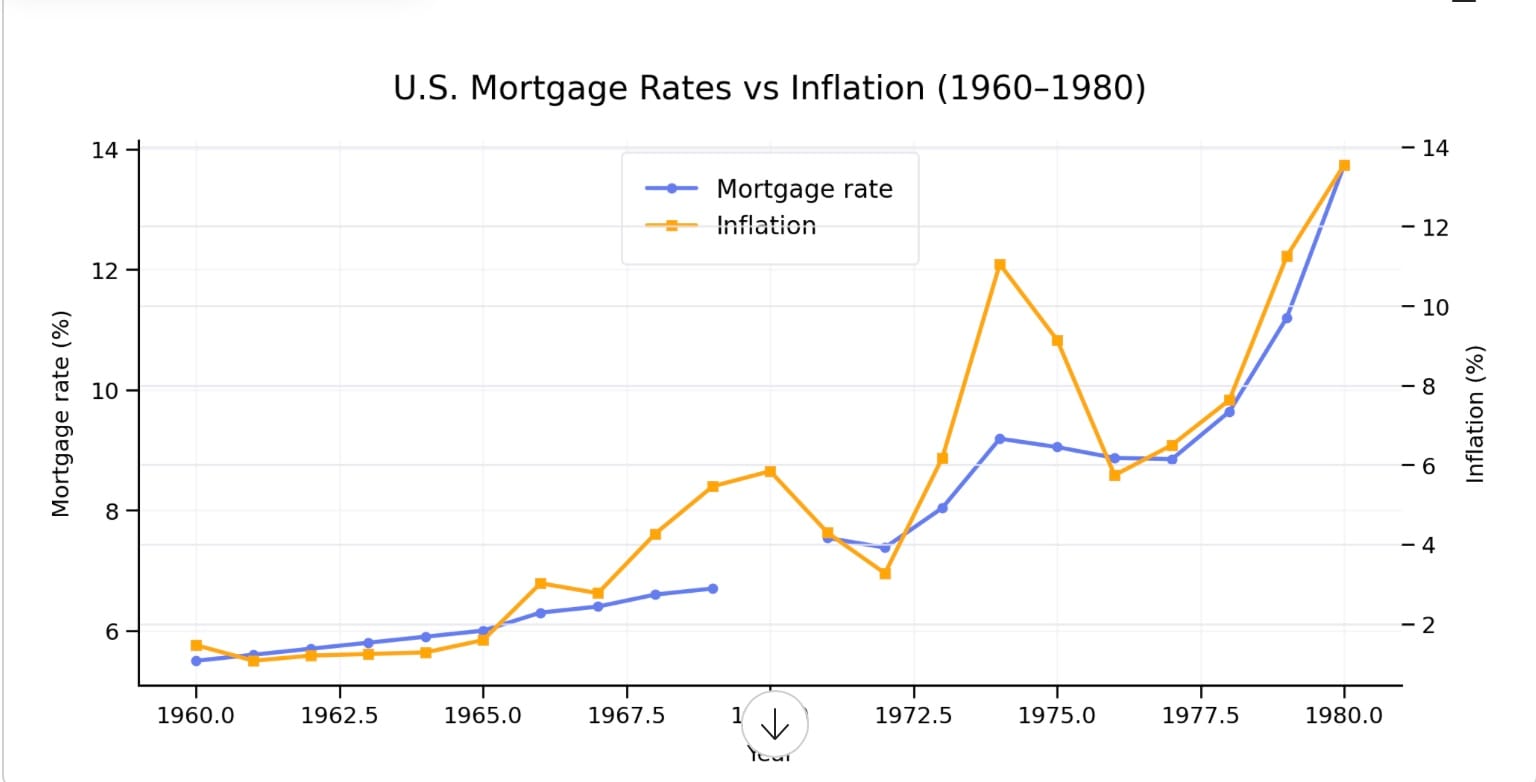
This is a simple Python created chart. As you can see, continuous date was not always prior to 1970.
1) Inflation (1960–1980)
- The inflation series is fully continuous and official, based on CPI annual percent changes.
- For example, inflation rises from about ~1–2% in the early 1960s to double digits by 1979–1980.
2) Mortgage rates (1960–1980)
- Reliable 30-year mortgage data only begins in 1971 with Freddie Mac’s survey.
- For 1960–1969, I used reasonable approximations (≈5–6.7%) based on historical summaries of the decade.
- The 1960s were characterized by relatively stable mortgage rates around ~5.7% on average, rising gradually.