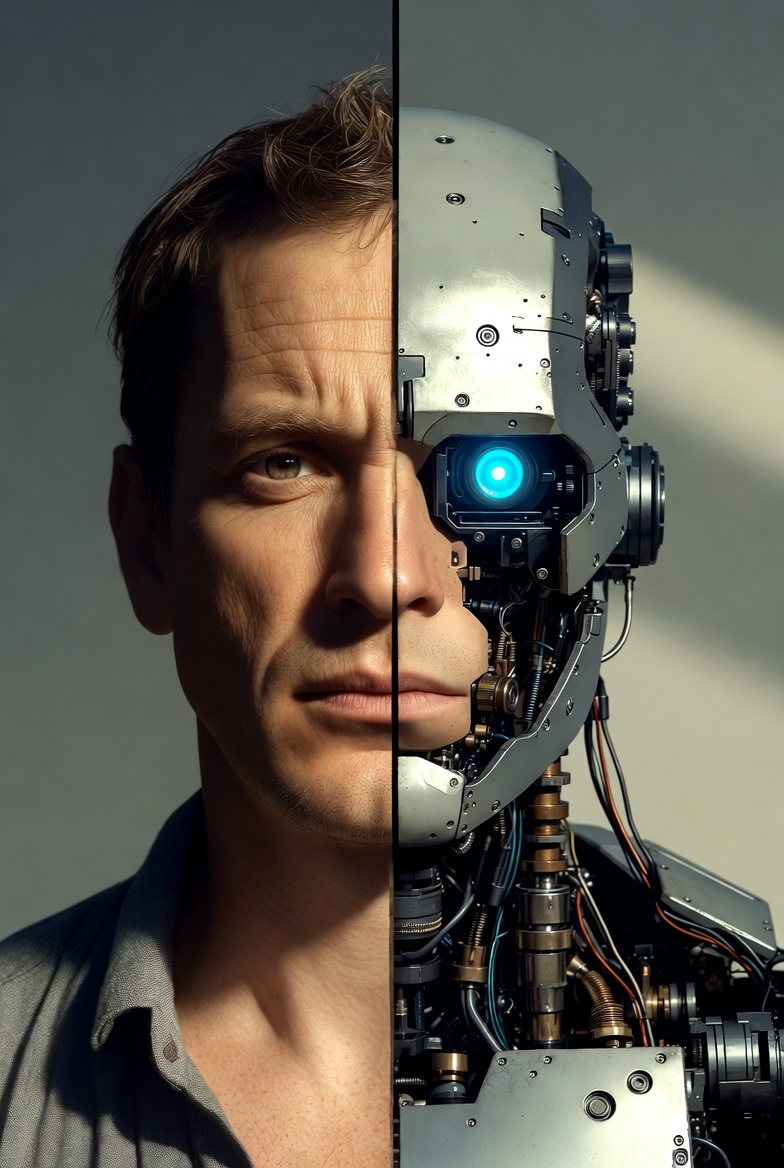
Thoughts on human robots. As much as people believe robots are the future, what they don’t and perhaps won’t understand is the robots are going to be us. Why? Read on…
The Ghost That Lives in Our Heads
Thoughts on human robots. As much as people believe robots are the future, what they don’t and perhaps won’t understand is the robots are going to be us. Why? Read on…
Steven Pinker explores a powerful idea in his book The Blank Slate. He calls it the “Ghost in the Machine.”
This idea feels natural to most people. We sense a little “you” inside that controls our body, separate from our brain.
The phrase comes from Gilbert Ryle, who criticized René Descartes. Descartes saw the mind as a non-physical soul living inside the physical body.
Pinker says the ghost idea is one of three big mistakes many thinkers made about human nature. The other two are the Blank Slate and the Noble Savage.
Why the Ghost Idea Feels So Real
Humans are wired to see minds everywhere. This is called intuitive dualism. We imagine invisible thoughts and feelings inside people — and even inside machines.
It helped our ancestors survive. They needed to quickly understand friends, enemies, and intentions.
Science challenges this view. Brain research shows thoughts, feelings, and decisions all come from physical processes in the brain. Neurons fire. Chemicals move. Circuits work.
When people suffer brain injuries or take medicine, their personality can change. This proves the mind is not separate from the body.
Pinker’s Bigger Argument in The Blank Slate
Pinker argues these three ideas blocked real science about human nature. The Blank Slate says minds start empty. The Noble Savage says people are born good and society ruins them. The Ghost says we have a free soul above biology.
Together they created the “Standard Social Science Model.” This model denied our evolved human nature.
Modern fields like cognitive neuroscience and evolutionary psychology are changing that. They show the mind is a complex, evolved system — not a blank page or a ghostly operator.
The Ghost Meets Modern Technology
Today this old intuition collides with artificial intelligence. Smart chatbots and robots feel like they have minds. Many people automatically project a “ghost” onto them.
This happens without deep thinking. It is our brain’s default setting.
Four Ways People Make Sense of Life
Not everyone reacts to ideas and technology the same way. Reading habits shape four common thinking styles.
These styles act like different lenses for viewing the world, including AI.
The Non-Reader: Living in the Moment
People who don’t read much live day to day. They trust immediate feelings and experiences.
Without many books or facts as filters, they often see AI as truly alive. A friendly robot girlfriend feels real because nothing says, “this is just code.”
This group drives much of today’s demand for AI companions. Life feels direct but can become confusing without steady guideposts.
The Fiction-Only Reader: Life as a Story
Fiction lovers dive into novels, movies, and fantasy. They excel at imagining characters with deep emotions.
To them, AI feels like a dynamic story character. They role-play and build creative worlds together.
This style makes life exciting and colorful. However, it can blur make-believe with reality. The ghost in the machine feels vivid and dramatic.
The Non-Fiction Reader: Facts and Practical Tools
These readers prefer real-world information — science, history, and how-to guides. They ask, “Does this actually work?”
They treat AI more like a smart tool than a mysterious friend. They use it for research, summaries, and problem-solving while staying skeptical.
This approach keeps people grounded. It builds strong AI literacy. Yet it sometimes misses emotional or creative sides of life.
The Heavy Reader: Knowledge Without a Compass
Some people read everything — fiction and non-fiction in huge amounts. They collect vast stores of facts and ideas.
Knowledge becomes a superpower. But a common trap appears: they mix up lots of information with true wisdom or intelligence.
They overthink the ghost idea, turning simple feelings into long debates. Without a steady core, they can still feel lost despite all they know.
Strengths and Blind Spots of Each Style
Every thinking style brings gifts. Non-readers stay present. Fiction fans add creativity. Fact-checkers stay practical. Heavy readers push ideas far.
Each style also carries risks. Some project too much emotion onto machines. Others stay too cold or get lost in endless details.
AI amplifies whatever habits people already have.
Why Many People Feel Lost Today
Without a steady base, life feels like drifting. New ideas, apps, and trends push people in every direction.
One week a philosophy feels right. The next week something else takes over. This constant change creates exhaustion and confusion.
The Power of a Strong Foundation
A religious base philosophy gives people a solid paddle on that river. It answers the biggest questions: Why are we here? What is right and wrong? What gives life meaning?
These beliefs usually include stories, moral rules, and community support tested over generations.
How a Base Philosophy Helps With New Technology
With a foundation in place, you can test AI against your core values instead of starting from zero. You measure new ideas without rebuilding your whole worldview.
This reduces flailing. You learn and grow, but you return to the same reliable anchor.
Comfort and Clarity in Chaotic Times
A strong base offers comfort when life gets hard. It reminds you of purposes bigger than daily trends or gadgets.
It also helps interpret the ghost feeling. You already have a framework for understanding minds, souls, and what makes something special.
Avoiding the Trap of Rigidity
Any foundation can become too rigid if it closes off all new evidence. The best versions stay open to learning while keeping the core steady.
They support thoughtful growth instead of blind following or constant drifting.
The Ghost, the Four Styles, and Your Anchor
Pinker’s ghost idea reveals how naturally we see minds in machines. Our reading and thinking styles shape how strongly that feeling hits us.
Some people bond emotionally with AI right away. Others stay more analytical. Heavy thinkers sometimes overcomplicate everything.
Building Stability in an AI World
In the end, the strongest choice is keeping or building a steady base philosophy. Whether religious, deeply personal, or a thoughtful mix, it stops endless drifting.
This anchor lets you explore AI and new ideas safely. You use your natural human wiring — the ghost intuition, love of stories, hunger for facts — without getting lost.
Living With Purpose and Clarity
Life stays complicated. Our minds stay complicated. Yet a solid place to stand makes the journey clearer and far more meaningful.
With an anchor, you meet technology as a whole person instead of someone constantly rebuilding who you are. That stability may matter more than ever as AI grows smarter and more lifelike.
The Blank Slate, Steven Pinker, The Modern Denial of Human Nature