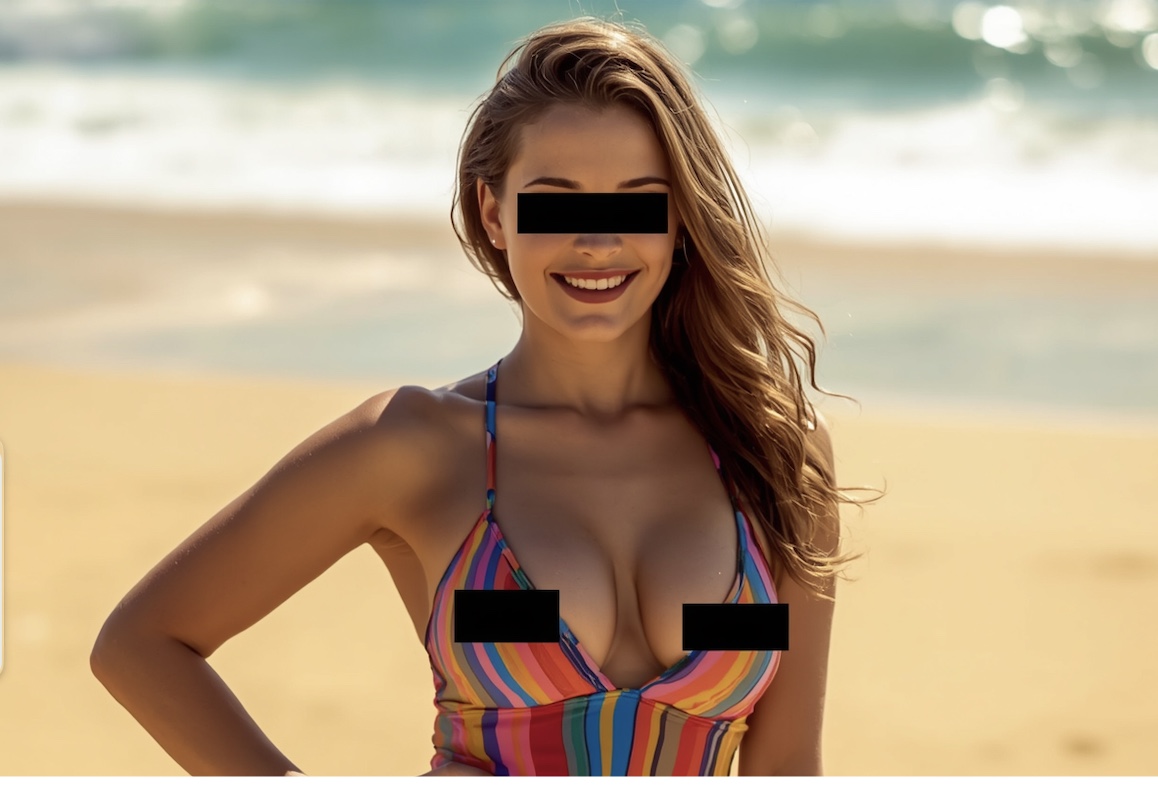
In the great fortress of modern media, there exists an invisible line. Not a moral line, not a philosophical line, not even a particularly well‑reasoned line.
No—this is a far more sacred boundary.
This is The Nipple Standard.
The Line That Must Not Be Seen
The rule is simple:
- Above the nipple → safe, wholesome, educational, suitable for children, possibly sponsored by breakfast cereal
- Below the nipple → unspeakable degeneracy, adult content, file under “do not let your grandmother see this”
Naturally, between these two zones lies… absolutely nothing. No nuance. No ambiguity. No middle ground. Just a thin line of moral electrification.
You might think:
“Surely modern storytelling has evolved past this?”
Oh, my sweet summer viewer. No.
We have simply built an entire global entertainment system around it.
Meet Miss Beatrice Pennington
Every empire needs a ruler.
In this one, she sits cross‑legged on a wooden desk.
Her name is Miss Beatrice Pennington, Third Grade Educator Emeritus and Supreme Executive of Narrative Compliance.
She oversees everything.
Picture her:
- Cardigan buttoned too high
- Glasses hanging halfway down her nose
- A ruler—not metaphorical—tapping rhythmically against her palm
- Feet swinging slightly above the floor
Behind her: twenty-seven screens, each displaying a different film in progress.
She sighs.
“No, no, no… Jeremy, what did we say about tension?”
She presses a button. A sniper misses again—on purpose.
The Rules of the Classroom
Miss Pennington’s guidelines are clear. She repeats them every morning before the global writing room logs in.
“Children,” she says, adjusting her posture,
“we have standards.”
She then writes them on the chalkboard:
- The Hero Must Always Win (Eventually, preferably immediately)
- The Bad Guys Must Be Clearly Bad (no complicated ideas please)
- No Confusing Emotions During Action Sequences
- No Nudity That Might Cause Questions
- Explosions Are Encouraged, Preferably Every 6–8 Minutes
A student raises a hand.
“Miss Pennington, what about… ambiguity?”
She pauses. Turns slowly.
“Ambiguity,” she says,
“is for Europe.”
Case Study: The Perfect Gunfight
We now observe a standard Miss Pennington-approved action sequence:
- The hero enters a room with twelve armed opponents
- The lighting is dramatic but not too scary
- Music swells in a non-threatening way
The hero fires once.
Every shot:
- hits center mass
- lands perfectly
- carries moral authority
The villains:
- fire constantly
- miss completely
- occasionally hit walls for visual interest
Miss Pennington claps lightly.
“Very good,” she says. “See? Clear, instructive, no confusion.”
A small cough from the back.
“But… shouldn’t there be uncertainty?”
She sighs again.
“Uncertainty leads to anxiety. Anxiety leads to questions. And questions…”
(she lowers her glasses)
“…lead to discussions about the human body.”
The room falls silent.
The Forbidden Zone
Behind Miss Pennington’s desk is a locked cabinet.
Inside: the things that must never be shown.
Not war.
Not violence.
Not existential collapse.
No.
Inside are:
- realistic vulnerability
- imperfect bodies
- moments that are not easily categorized
And of course:
The Nipple.
She has labeled the drawer:
“DO NOT OPEN – MAY CAUSE COMPLEX THOUGHT”
The Educational Programming Mandate
Miss Pennington believes—not ironically—that all media is educational.
But not in the way you might think.
Lessons include:
- “Good people are accurate”
- “Bad people are incompetent”
- “Conflict is resolved through decisiveness and superior posture”
- “The body is mysterious and possibly dangerous—avoid visual confirmation”
She paces slightly on her desk.
“We’re not lying,” she tells the producers.
“We’re simplifying.”
The Result
After years of careful instruction, the system hums perfectly.
Viewers receive content that is:
- visually impressive
- emotionally manageable
- morally unambiguous
- biologically evasive
Stories where:
- bullets obey hierarchy
- heroes embody certainty
- reality is… politely reorganized
And always, always:
Nothing crosses the line.

A Moment of Rebellion
One day, something happens.
A director quietly suggests:
“What if… the hero misses?”
Miss Pennington freezes.
Her foot stops swinging.
The room temperature drops two degrees.
“Misses?” she repeats softly.
A writer, emboldened, adds:
“And maybe… the enemy isn’t entirely wrong?”
She stands.
The ruler taps once. Twice.
“Children,” she says calmly,
“this is how confusion begins.”
Another hand rises.
“What if… people are just people?”
Silence.
For a moment—just a moment—it seems like something might change.
Miss Pennington considers this.
Then she smiles.
It is not a warm smile.
Back to Work
She sits again, crossing her legs neatly.
“Let’s not get carried away,” she says brightly.
“Now, from the top. Scene 47.”
On screen:
- the hero reloads efficiently
- the villains reposition themselves incorrectly
- the music swells again
Everything is as it should be.
✅ Conclusion: Order Restored
So yes—when you look at modern mainstream media and feel like something is off…
You’re not wrong.
You’re watching a system designed to:
- avoid discomfort
- prevent ambiguity
- maintain control
All while enforcing a peculiar, unwavering rule about where morality ends and scandal begins.
And somewhere, in a high office that looks suspiciously like a third-grade classroom, Miss Beatrice Pennington adjusts her glasses and nods approvingly.
“Very good,” she says softly.
“Nothing above the line. Nothing below the line.”
She taps her ruler.
“Now… give me another explosion.”
If you want, I can write a darker version of this where the “classroom” starts breaking down and the rules stop holding—same idea, but more unsettling.